Answer a gate
A gate is a point where a flight waits for a person to approve or reject something, such as a pull request or a running preview. Use this guide when a flight is waiting on a decision: to find it, to understand exactly what is being asked, and to record an answer. Nothing behind a gate proceeds until someone answers it, and waiting at a gate does not end the flight.
Prerequisites
Section titled “Prerequisites”- gg is signed in to the organisation’s control plane.
- The person answering is the gate’s approver, or may otherwise decide it. Who may decide a gate explains the rules.
1. List what is waiting
Section titled “1. List what is waiting”Run gg gates:
gg gates1 decision(s) waiting.
GG-42 - code-review approver: platform-owner commit: 3f2c1e9 on refs/heads/gg/GG-42 when: always (this obligation declares no condition) because: <why the gate opened> since: 2026-10-14 14:38:03ZEach entry names the flight and the obligation, which is the thing awaiting a decision. The lines below it say:
| Line | Meaning |
|---|---|
approver |
Who the rules say may decide it: a role, such as platform-owner, or a named person. |
commit |
The commit and branch the decision is about. A decision that does not concern a repository says none - this decision is not about a repository. |
when |
The condition that made this obligation apply. always means the obligation has no condition. |
because |
Why the gate opened. When the agent stopped to ask a question, the question is the end of this sentence. |
since |
When the gate opened. |
When a flight was proposed by an agent, the entry adds a block that begins an agent proposed this flight, in its own words, followed by the kind of work, the environment and repository it asked for, its reason, and any note it left for the next agent. Those are the agent’s words, not the organisation’s rules, and the person answering the gate is the only review they get before they reach the next agent.
When nothing is waiting, gg says Nothing is waiting on a decision.
2. Read why the flight is stopped
Section titled “2. Read why the flight is stopped”gg why explains every obligation on a flight: whether it applied, why, and what was decided.
gg why GG-42GG-42 — governed by envelope v20
code-review: attached when: always (this obligation declares no condition) history: attached 14:38
in-scope: attached when: always (this obligation declares no condition) verdict: satisfiedTo read one obligation only, name it: gg why GG-42 code-review.
The first line names the version of the rules (the envelope) that governs the flight. After it, gg may print two kinds of notice before the obligations:
HALTED:followed by a reason. Good Grief found a rule it could not evaluate, so the flight stopped instead of guessing. The flight is still open.- A held leg. When the flight is a leg of a plan that is waiting for another leg, a sentence names the leg it follows and how that leg ended.
Each obligation then appears as <obligation>: <whether it applied>, where the second part is one of:
attached: the obligation applies to this flight.not-attached: its condition was checked and did not hold.unevaluable: its condition could not be answered.
The indented lines under it say more:
| Line | Meaning |
|---|---|
never |
This kind of work can never produce what the rule depends on, so the rule can never apply. This differs from a rule that was checked and did not apply this time. |
when |
The obligation’s condition. |
history |
Each change in whether it applied, with the time, such as attached 14:38 -> not-attached 14:51. |
because |
Why it applied or did not. |
verdict |
The result: satisfied, violated or unevaluable. An obligation with no verdict has not been decided yet. |
detail |
More about the result, such as the files outside the allowed scope. |
When gg prints Nothing has been judged against this flight., either the envelope declares no obligation or nothing has been evaluated yet. A flight that has not reached its first gate reads this way; gg show gives the stage it is at.
3. Record a decision
Section titled “3. Record a decision”Run gg decide with the flight, the obligation and the outcome, approved or rejected, followed by a reason:
gg decide GG-42 code-review approved "Correct, and the test covers the expiry path."A reason is optional when approving and required when rejecting. A reason may be up to 4,000 characters; a longer one is refused, not shortened.
gg records the decision, then watches the gate until the decision is visible, and reports what it saw:
decided: the obligation is now satisfied looked: 2 time(s) over 1.5s of a 30s bound decided: approved by: Ada Lovelace at: 2026-10-14 14:52:10Z landing: not yet - something else this destination requires is outstanding- The first line is one of three:
decided:with what the obligation became,refused:with the reason the control plane gave, ornot yet visible:. The last is not a failure. The decision was sent, and gg stopped watching before it appeared. Rungg gatesto check before sending it again. lookedsays how many times gg checked and for how long.landingsays whether the work may now be accepted at its destination.not yetmeans another requirement of the destination is still outstanding. Otherwise the line names the destination and why it now accepts the work.
A decision applies to the gate as it was when gg looked it up, for that exact version of the work. When no gate is open for that obligation, because it has already been answered or a new attempt replaced it, gg says that nothing is waiting on a decision about it and suggests gg gates.
What rejecting does
Section titled “What rejecting does”Rejecting sends the work back. The agent makes another attempt, with the reason attached, which is why a rejection needs a reason that says what to change. gg show numbers the attempts #1, #2 and so on.
Rejecting the gate of a plan a person proposed is different: every leg of that plan that is still waiting is declined, and the plan’s flight ends withdrawn. Plan with itineraries covers plans.
Who may decide a gate
Section titled “Who may decide a gate”The approver line says who the rules expect to decide. An approver is written in one of two ways:
- A role, such as
platform-owner, written as a bare word. - A named person, written as
<provider>:<subject>, the formgg whoamiprints.
When the approver is a role, the control plane does not check the role: anyone in the organisation who may decide gates can answer it. To limit a gate to one person, name that person as the approver.
When the approver is a named person, only that person can decide the gate. The control plane refuses anyone else, including an administrator, and says whose gate it is. Gates that belong to a person’s own watch work the same way: only that person can answer them. Set up a watch explains personal watches.
The same steps in the console
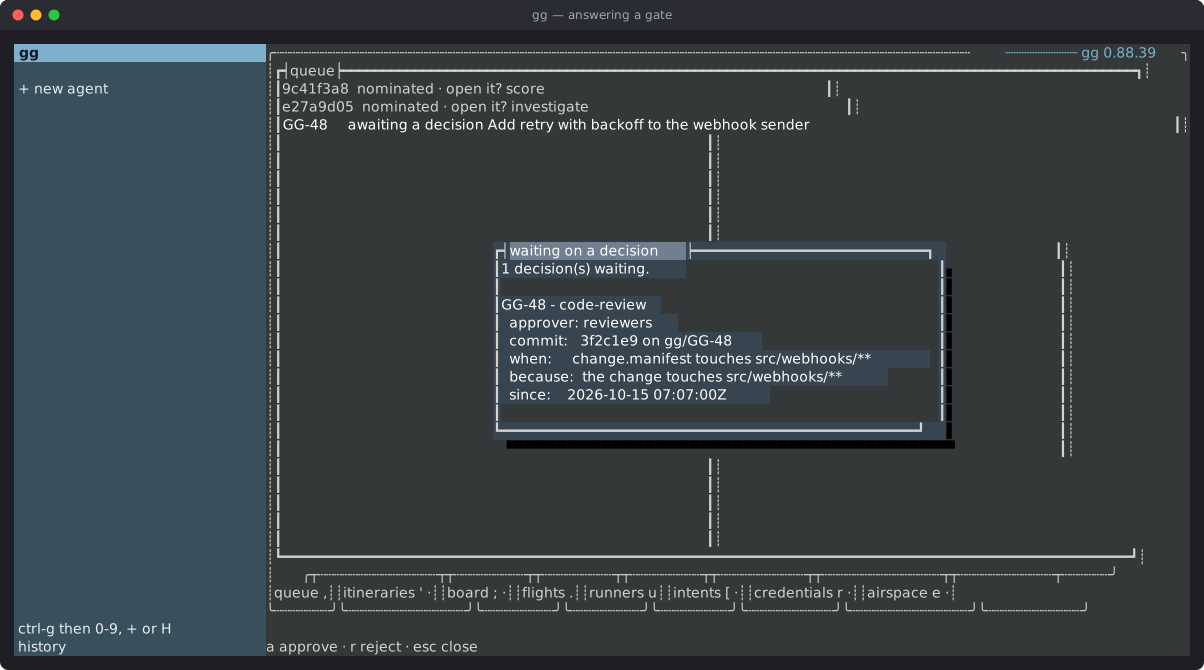
Section titled “The same steps in the console”Run gg with no arguments, then:
,opens the queue, which lists what is waiting on a person.dstarts deciding the selected flight’s gate. In the window that opens,aapproves,rrejects andesccloses without deciding.- On an open flight,
aapproves andrrejects when a gate is waiting. - When a gate is a runner asking for its agent to be signed in,
ssigns the agent in instead.
Related
Section titled “Related”- The envelope: obligations: how obligations, conditions and approvers are declared.
- Anatomy of a flight: why a gate does not end a flight.
- Take over a flight: continuing the work by hand instead of sending it back.